Seamlessly Move Your Home and Car: A Step-by-Step Guide
Relocating your home and vehicle simultaneously presents a significant logistical challenge. Many individuals approach this task by treating home moving and car shipping as separate endeavors, often leading to added stress, potential miscommunication, and unexpected costs. This guide offers a strategic, step-by-step roadmap designed to integrate these two complex processes seamlessly. By planning holistically and understanding the interconnected details, you can transform a daunting move into a smooth, efficient experience. We will navigate each phase, from initial planning and budgeting through to post-move essentials, ensuring you have the critical information needed to manage your home and vehicle relocation with confidence.

*This post may contain affiliate links and I'll earn a commission if you shop through them. You can read my full disclosure here.
Phase 1: Strategic Planning & Budgeting (3-6 Months Out)
Establishing Your Integrated Moving Timeline
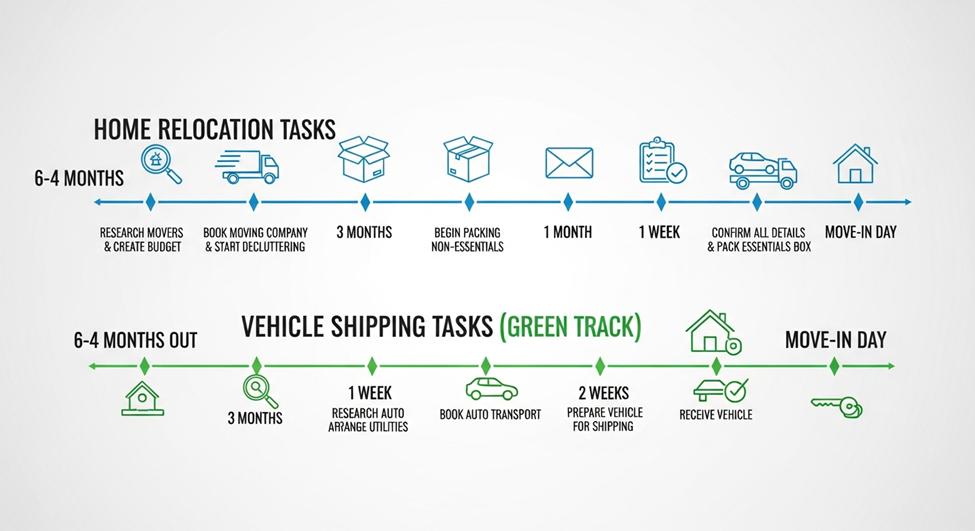
This integrated timeline visualizes key milestones for both your household move and vehicle transport, helping you coordinate tasks from 6 months out to your final move-in day.
The foundation of a successful dual relocation lies in a well-defined timeline. Start by establishing a comprehensive schedule that accounts for both your household goods and your vehicle. Work backward from your desired move-in date, allotting sufficient time for each stage. Consider factors like the distance of the move, the seasonality of moving services (peak times like summer can significantly impact availability and cost), and the lead time required by your chosen moving business and auto transport providers. Setting clear milestones for packing, utility changes, vehicle preparation, and administrative tasks is crucial.
Budgeting for Your Entire Relocation
A holistic budget is paramount. Beyond the typical expenses for household moving, factor in the specific costs associated with vehicle transportation. This includes the base shipping fee, potential surcharges based on vehicle type, size, or condition, and any additional services like expedited delivery. Researching average costs for both services early on will prevent budget overruns. Obtain detailed quotes from multiple businesses, comparing not just the price but also the services offered and the level of customer support. Understanding the complete financial picture upfront is key to avoiding surprises.
Choosing Your Moving & Car Shipping Partners
Selecting the right partners is critical for a seamless experience. For a truly hands-off transition, many homeowners now look for a specialized moving company that offers a comprehensive full-service moving package. Such providers simplify the entire coordination by managing the packing of your smallest household items while simultaneously arranging for professional car shipping. Integrated services like these offer a single point of contact and bundled pricing, ensuring that both your boxes and your vehicle are tracked under one unified logistics plan.
Selecting the right partners is critical for a seamless experience. Look for established businesses with a proven track record in both household moving and vehicle transport. Integrated services can often simplify coordination, offering a single point of contact and potentially bundled pricing. Thoroughly vet potential companies by checking online reviews, asking for references, and reviewing their websites for detailed information about their operations and customer service. Don't hesitate to contact them directly to discuss your specific needs and gauge their responsiveness and support capabilities.
Comprehensive Insurance for Home & Car During Transit
Adequate insurance coverage is non-negotiable for protecting your valuable assets. For your home contents, understand the types of coverage your moving company offers, such as declared value or full replacement value protection. Similarly, for your vehicle, explore options like carrier liability insurance and the possibility of extending your personal auto insurance. Ensure you have all the necessary insurance details and contact information readily available. Prioritizing the safety and security of your belongings and your vehicle through robust insurance policies provides essential peace of mind.
Phase 2: Preparing Your Home for Departure (2-3 Months Out)
Decluttering, Downsizing, and Inventory
Before packing a single box, dedicate time to decluttering. This process not only reduces the volume of items to be moved but also saves you time and money. Conduct a thorough inventory of your belongings, noting high-value items and anything requiring special handling. This inventory serves as a critical reference for insurance claims and helps in organizing your packing efforts. It's also an excellent opportunity to decide what to keep, sell, donate, or discard, simplifying the entire moving process for your Home.
Packing Strategies and Supplies
Effective packing is essential for the safety of your possessions. Invest in quality packing supplies: sturdy boxes, packing tape, bubble wrap, and markers. Label each box clearly with its contents and the room it belongs to at your new home. For fragile items, use ample cushioning and consider packing similar items together. Professional movers can offer guidance and supplies, ensuring a consistent experience. Efficient packing minimizes the risk of damage during transit and facilitates easier unpacking upon arrival.
Managing Utilities and Address Changes
Begin the administrative process of changing your address well in advance. Notify utility companies (electricity, gas, water, internet, cable) of your move-out date for your current home and arrange for services to be connected at your new address. Simultaneously, start the official change of address process with postal services and any relevant government agencies. This proactive step ensures you don't miss important mail or experience service disruptions, contributing to a smoother transition for your new Home.
Phase 3: Navigating Vehicle Relocation Logistics (1-2 Months Out)
Selecting the Right Car Shipping Method
Several methods exist for transporting your vehicle, each with its own benefits and costs. Open-air transport is generally more budget-friendly, while enclosed transport offers enhanced protection for luxury or classic cars. Door-to-door service provides maximum convenience, whereas terminal-to-terminal requires drop-off and pick-up at designated facilities. Consider factors like transit time, cost, and the specific needs of your vehicle when making your choice. Understanding these options ensures you select the best fit for your automobile.
Getting Quotes and Understanding "Auto Transport" Costs
Obtain detailed quotes from multiple auto transport businesses. Be prepared to provide specific details about your vehicle, including its make, model, year, and any modifications. Factors influencing cost include distance, the chosen shipping method, the time of year, and the company's pricing structure. Clarify what is included in the quote - for instance, if fuel surcharges or tolls are part of the general cost. Understanding these details helps in accurately budgeting for your vehicle's move and comparing offers.
Preparing Your "Vehicle" for Transport
Proper preparation of your vehicle is crucial for safety and to comply with transport regulations. Clean your car inside and out; this aids in documenting its condition. Remove all personal belongings, non-factory-installed accessories, and any hazardous materials. Ensure your vehicle has adequate fuel (typically one-quarter tank or less) and that it is in operational condition if necessary for loading/unloading. A well-prepared vehicle ensures a smoother pick-up and delivery experience.
Essential Vehicle Documentation for Transport
Gather all necessary documentation for your vehicle. This typically includes proof of ownership, such as the vehicle's title, and your driver's license. Some auto transport companies may require a registration document. Ensure you have copies of all relevant documents, as these are essential for both pickup and delivery. Having these details organized simplifies the process and avoids potential delays with the transport business.
Phase 4: Administrative & Legal Checklist (1 Month Out - Pre-Move)
Updating Your Legal "Address" and Driver's Documentation
It's imperative to update your legal address with all relevant authorities. This includes your local Department of Motor Vehicles (DMV) to change your driver's license and vehicle registration address. Failing to do so can result in legal complications and missed notifications. Ensure you understand the specific requirements and deadlines for updating your driver's title and vehicle details in your new locale.
Managing Mail, Subscriptions, and Voter Registration
Beyond official mail forwarding, update your address with all subscription services, banks, credit card companies, employers, and any other recurring services. This ensures continuity and prevents important correspondence from being missed. If you are changing states, research the process for updating your voter registration to ensure you can participate in upcoming elections in your new community.
Important Financial and Legal "Property" Transfers
Review any financial or legal property transfers that may be required. This could involve updating beneficiaries on insurance policies, notifying lenders of your new address, or making arrangements for any ongoing legal matters. If you are selling a current property or purchasing a new one, ensure all paperwork related to these transactions is completed, and any title changes are processed correctly.
Phase 5: Financial & Tax Considerations for a Seamless Transition
Understanding Deductible Moving Expenses
Depending on your employment situation and location, certain moving expenses may be tax-deductible. Consult with a tax professional or research current tax laws to understand what qualifies, such as the cost of moving your household goods. Keeping detailed records of all moving-related expenses, including receipts, is crucial for any potential tax claims.
Navigating "Property Taxes" and "Vehicle Tax" in Your New Location
Each state and local jurisdiction has its own tax regulations. Familiarize yourself with the property tax rates in your new area, as these can significantly impact your homeownership costs. Additionally, research vehicle tax requirements, including registration fees and annual taxes, which can vary widely. Understanding these financial obligations helps in accurately budgeting for your new Home and vehicle.
Phase 6: Moving Day Execution & Arrival Logistics
Coordinating "Moving Day" for Your Home
Moving day requires meticulous coordination. Ensure movers arrive on time and are aware of the inventory. Supervise the loading process to confirm all items are accounted for and handled with care. Do a final walk-through of your old home to ensure nothing is left behind and utilities are properly shut off. Clear communication with your moving business is vital throughout this phase.
Receiving Your Vehicle: "Delivery Day" Checklist
When your vehicle is delivered, conduct a thorough inspection with the driver before signing any paperwork. Document any existing damage with clear photos and note it on the delivery receipt. Compare the condition of your vehicle against the pre-transport inspection report. Verify all documentation is in order. This attention to detail on delivery day ensures your vehicle is returned in the expected condition.
Settling into Your New "Home"
Upon arrival at your new home, begin unpacking systematically. Prioritize essential rooms like the kitchen, bedrooms, and bathrooms. Direct movers to place boxes in their designated rooms to streamline the unpacking process. If your vehicle has arrived, ensure you have a safe place to park it. The initial days are about establishing comfort and order in your new living space.
Phase 7: Post-Move Essentials & Troubleshooting
Completing Post-Move Administrative Tasks
The work isn't entirely done once you've arrived. Complete any remaining administrative tasks, such as updating your address on your driver's license and vehicle registration if you haven't already. Ensure all utilities are functioning correctly and set up any new services. Verify that your mail forwarding is working as expected.
Common "Problem" Scenarios and Solutions
Despite meticulous planning, minor issues can arise. If you discover damaged items, contact your moving company's customer support immediately with photographic evidence and a detailed report. For vehicle transport issues, reach out to your auto transport provider. Having all your documentation, insurance details, and contact information accessible will expedite the resolution process. Proactive support from your chosen businesses is key.
Conclusion
Seamlessly moving your home and car is achievable with strategic planning, diligent execution, and careful consideration of both your household goods and your vehicle. By integrating the logistical, administrative, and financial aspects of your relocation from the outset, you can minimize stress and avoid common pitfalls. This step-by-step guide has provided a framework to navigate this complex process, emphasizing proactive communication with your chosen moving and car shipping businesses, thorough budgeting, comprehensive insurance, and timely administrative changes. Remember that each point discussed, from establishing your timeline to confirming vehicle delivery, contributes to a more manageable and positive moving experience. By leveraging detailed information and maintaining a focus on safety and support, you pave the way for a smooth transition and a successful start in your new home.