How to Budget for a Rent Increase When Renting in London
Opening a letter that says your rent is going up can knock the wind out of any London renter. The capital already carries the highest rents in the country, with the average private tenant paying around £2,290 a month in spring 2026. Even a modest rise of a few percent adds hundreds of pounds to your yearly outgoings.
The good news is that rent growth in London has cooled sharply, and new rules give you more protection than before. A little planning now means the next increase does not derail your finances. Here is a practical way to build a budget that can take a rise in its stride.

From time to time, articles on The How-To Home may reference third-party websites, businesses, products, services, or review platforms as part of editorial research. When evaluating companies or services, we may consider publicly available information such as customer reviews, business websites, service offerings, licensing information when available, and overall relevance to the topic.
Key Takeaways
- London has the priciest average rent in England, about £2,290 monthly, yet annual growth has eased to roughly 2%.
- Since 1 May 2026, a landlord can raise rent only once a year using a Section 13 notice.
- Aim to keep rent near a third of your income and hold a one to two month buffer.
- You get two months of notice and can dispute an unfair rise at a tribunal for £47.
- Mapping council tax, bills and deposit costs stops a rise catching you off guard.
How Much Should You Budget for a London Rent Rise?
Plan for a yearly rise of roughly 2% to 5% on your current rent, then save a buffer on top. London's typical annual jump has slowed to about 2%, though asking prices on brand new tenancies can climb faster. A cushion of one to two months of rent absorbs most surprises.
Portland Estate and Letting Agents notes that the average rent increase in London has become far easier to predict than it was during the frantic market of 2022 and 2023.
Rather than fearing a vague leap, tie your buffer to a real figure. If your rent sits at £1,800, a 5% rise means £90 more a month, or £1,080 across the year. Saving that quietly in the background turns a shock into a shrug.
| Current monthly rent | Extra with a 3% rise | Extra with a 5% rise |
|---|---|---|
| £1,500 | £45/month (£540/year) | £75/month (£900/year) |
| £1,800 | £54/month (£648/year) | £90/month (£1,080/year) |
| £2,290 (London average) | £69/month (£824/year) | £115/month (£1,374/year) |
| £2,800 | £84/month (£1,008/year) | £140/month (£1,680/year) |
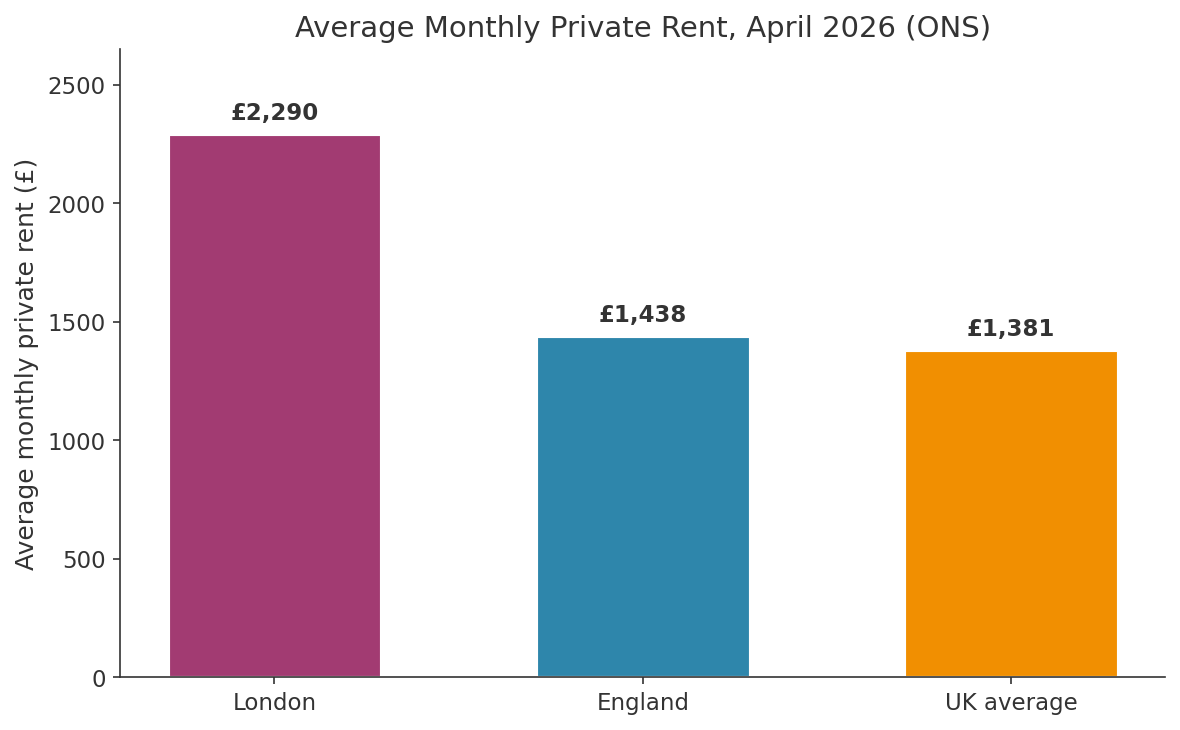
| Key figure: London's average private rent reached around £2,290 a month in April 2026, the highest of any English region, yet its annual growth was the slowest in the country. |
Why London Rents Are Rising More Slowly Than the Rest of the UK
London rents are climbing at the gentlest pace of any English region. In the year to May 2026, rents in the capital rose by just 2%, while the North East saw increases of almost 6%.
That gap marks a real shift. London rent inflation peaked at 11.5% in late 2024 before falling back, as tenants hit an affordability ceiling that landlords simply cannot push past.
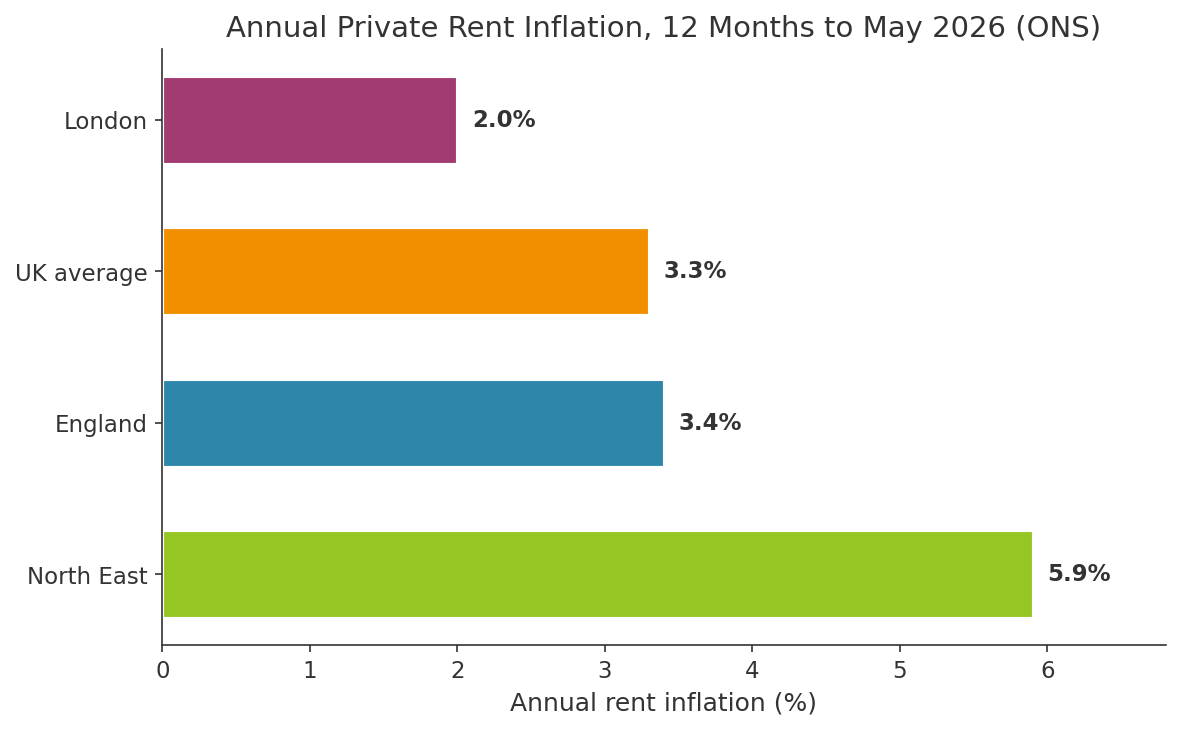
London rent inflation peaked at 11.5% in late 2024 before easing to around 2% by spring 2026.
Two measures can tell slightly different stories, so it helps to know which one you are reading. The official rental price data from the Office for National Statistics tracks rents across all ongoing tenancies, which move slowly. Asking prices for brand new lets can jump more, which is why some indices report the capital closer to 5%.
Know Your Rights Before You Build a Budget
Your rights as a renter changed on 1 May 2026, when the Renters' Rights Act came into force in England. A landlord can now raise the rent on a rolling assured tenancy in only one way, by serving a valid Section 13 notice on the correct form.
The rules are stricter than many tenants realise:
- Rent can go up only once every 12 months.
- You must receive a minimum of two months before the new rent starts, double the old period.
- The proposed figure has to reflect what similar properties in your area charge.
- Old rent review clauses and casual verbal agreements no longer count.
If a rise looks above the going rate, you can formally dispute the increase through the First-tier Tribunal, which decides a fair market rent. The application costs £47, and since the reforms the panel cannot set your rent higher than your landlord asked for.
| Rent rule | Before 1 May 2026 | From 1 May 2026 |
|---|---|---|
| How rent can rise | Review clauses, renewals or informal deals | Section 13 notice only |
| Frequency | Varied by agreement | Once every 12 months |
| Notice period | One month | Two months |
| Tribunal risk | Rent could be set higher | Cannot exceed the proposed rent |
| Pro Tip: A challenge only works if you apply before the new rent start date on your notice. Mark that date the moment the letter lands, and gather three or four comparable local listings as evidence. |
Few renters use this route. Shelter reports that only 1,532 tenants across England applied to a tribunal for a rent decision between 2024 and 2025, so a well prepared case can stand out.
Build a Budget That Can Take a Rent Rise
Start With the 30% Guideline
Housing experts suggest spending no more than 30% of your income on rent. Many Londoners stretch well beyond that, closer to 40%, which leaves little slack when a rise arrives. Treating 30% as your goal, even if you cannot always hit it, keeps your finances honest.
A simple framework is the 50/30/20 split, where half of your take-home pay covers needs, 30% covers wants, and 20% goes to savings and debt. Rent sits inside that first slice, so protecting the savings portion gives you the cushion a rise demands.
Map Every Housing Cost, Not Just the Rent
Monthly rent is only the headline number. Council tax, utilities, broadband and any service charge can add £200 to £400 each month across London, and those creep upward too.
Your deposit is worth planning for as well. Under current rules it is capped at five weeks of rent for most tenancies, or six weeks if your annual rent reaches £50,000 or more.
Create a Buffer Fund for the Next Rise
Set up a standing order that moves a small sum into a separate savings pot each payday. Even £40 to £60 a month builds a fund that covers the next rise without touching your day to day spending. If you also earn from working from home, directing part of that extra income into the same pot speeds things up.
Practical Ways to Absorb a Higher Rent
When a rise does land, a few adjustments can soften it. Small savings across several bills often add up to more than the increase itself.
- Trim energy costs with affordable home upgrades like LED bulbs and draught proofing.
- Review subscriptions and switch to a cheaper broadband or mobile deal.
- Consider a flatshare, which can cut rent and bills by roughly 40% to 50%.
- Cook in batches and plan meals to claw back grocery spending.
- Make more of what you already have, such as turning unused outdoor space into a reason to eat in rather than out.
Talking to your letting agent early helps too. One renter left a Google review describing how an agent named Mohan at Portland guided them patiently through a move and answered every question, which made the costs far easier to plan around. A good agent will explain the reasoning behind any rise and flag what comparable homes nearby are charging.
| Watch: "What renters and landlords need to know about UK's Renters' Rights Act" — https://www.youtube.com/watch?v=IYwVLtPTwUc. This short news explainer walks through the new limits on rent rises and the end of no-fault evictions. |
When to Negotiate or Challenge a Rent Increase
Not every rise is worth fighting, but every one is worth checking. Start by researching what similar flats nearby actually let for, using property portals and a quick chat with a local agent.
If your proposed rent matches the market, negotiating a smaller step or a longer notice window may serve you better than a formal dispute. If it clearly sits above fair value, the tribunal path costs little and carries no risk of a steeper outcome.
| Warning: Never stop paying rent while you dispute an increase. Keep paying the existing amount, because arrears can create separate problems even when your challenge is valid. |
Frequently Asked Questions
How much can a landlord increase rent in London?
There is no fixed cap. A landlord can propose any figure through the formal Section 13 process, but it must reflect local market rates. If the amount tops what nearby homes charge, you can ask a panel to set a fair rent.
How often can my rent be increased?
Once a year at most. Your rent also cannot rise during the first 12 months of the tenancy, and each increase needs a fresh notice served correctly.
What share of my income should go on rent in London?
Around 30% is the common benchmark, though many London tenants spend closer to 40. The lower your rent to income ratio, the more room you have to absorb a rise or save toward other goals.
How much notice must my landlord give?
At least two months, up from the single month required before the 2026 reforms. The notice must use the correct form and state the new rent and the date it takes effect.
Can I refuse a rent increase?
You cannot simply ignore a valid notice, but you can negotiate or apply to a tribunal before the start date. Until a decision is made, you keep paying your existing rent, not the proposed amount.
Planning Ahead Beats Reacting
A rise in London stings less when you have seen it coming and set money aside for it. Track the market rate for your area, keep your rent near a sensible share of what you earn, and let a small standing order quietly build your reserve. Pair that habit with a clear grasp of your Section 13 rights, and the next letter from your landlord becomes a number you have already planned for rather than a scramble you never expected.
References
Office for National Statistics, Private rent and house prices UK: June 2026, 2026 - https://www.ons.gov.uk/economy/inflationandpriceindices/bulletins/privaterentandhousepricesuk/june2026
Shelter England, Challenging a rent increase: the rules and what's changing, 2026 - https://england.shelter.org.uk/professional_resources/news_and_updates/challenging_a_rent_increase_the_rules_and_whats_changing
Citizens Advice, Challenging a rent increase, 2026 - https://www.citizensadvice.org.uk/housing/paying-rent/challenging-a-rent-increase/
GOV.UK, The Renters' Rights Act Information Sheet 2026, 2026 - https://assets.publishing.service.gov.uk/media/69bc04b8f7b1c24d8e23ce60/The_Renters__Rights_Act_Information_Sheet_2026.pdf
HomeLet, HomeLet Rental Index, 2026 - https://homelet.co.uk/homelet-rental-index
Fact Check: All statistics and data points in this article were verified against original sources as of 10 July 2026. Sources are listed in the References section.