Should You Repair or Replace Your Electric Hot Water System?
A few years ago, we were getting ready to celebrate my middle son's birthday. We had a big family dinner planned at a restaurant we'd never tried, about an hour's drive away. I ran out to pick up his cake and told everyone to be ready to go the minute I got back.
Less than an hour later, I pulled into the driveway, opened the garage door, and saw water running out of the laundry room and into the garage. Our water heater had let go. The entire lower level of the house was waterlogged... including my carpeted home office. Oh. My. Word.
I shut off the water to the house, grabbed my kids, and went to dinner anyway (that cake wasn't going to eat itself!). When we got home, the cleanup started, along with the phone calls trying to find someone who could get us a replacement fast. The new one went in on September 5, 2018, and that date is still written right on the tank.
Ours was a gas water heater, but electric tank systems can fail without warning too, and the lesson is the same either way. A water heater rarely gives you a convenient moment to decide whether to repair or replace it. So if yours is starting to act up, it's worth thinking it through now, before it makes the decision for you...
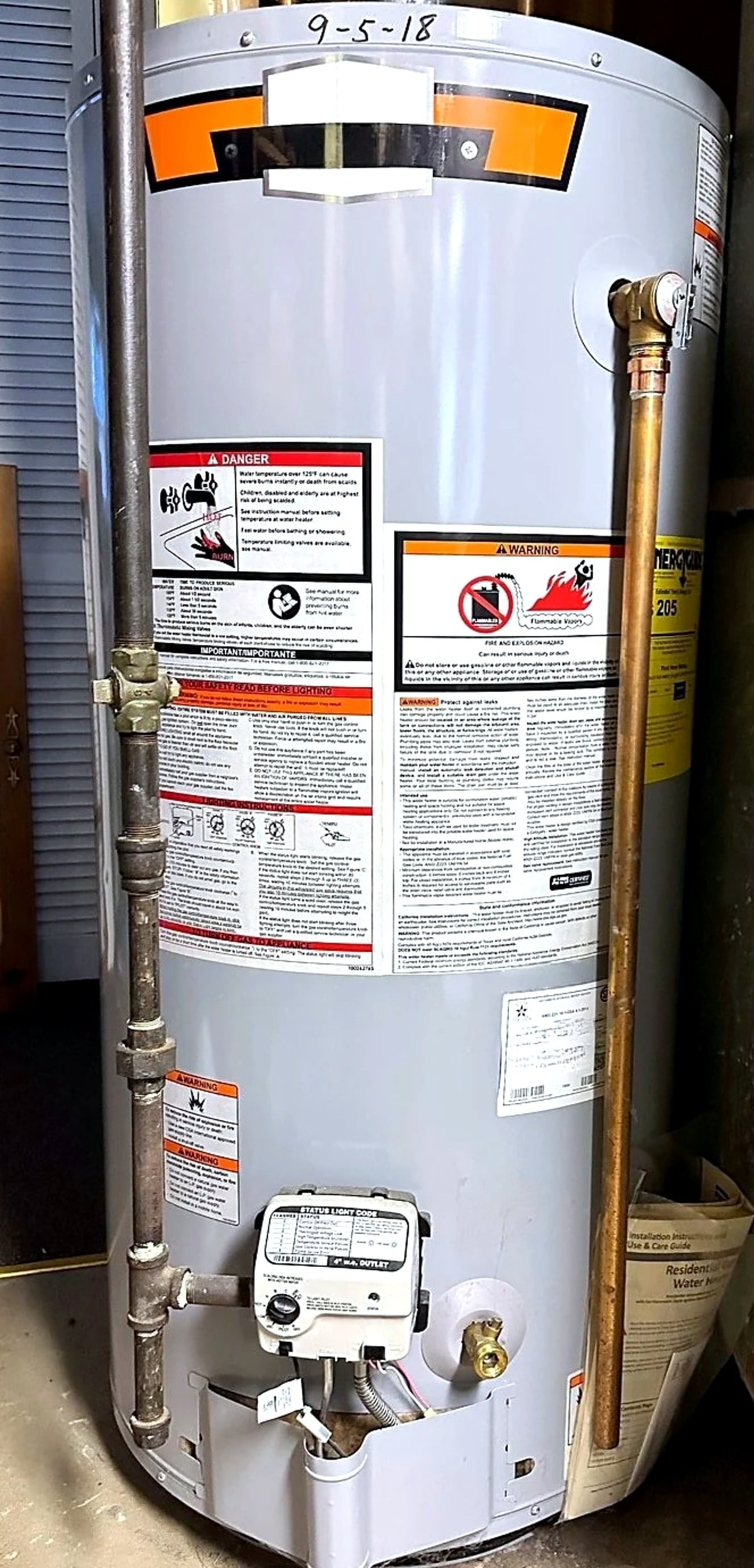
Our gas water heater now. Electric or gas, every tank water heater is worth keeping an eye on.
From time to time, articles on The How-To Home may reference third-party websites, businesses, products, services, or review platforms as part of editorial research. When evaluating companies or services, we may consider publicly available information such as customer reviews, business websites, service offerings, licensing information when available, and overall relevance to the topic.
A cold shower is a rough way to start the day, and the repair quote that follows can feel like a trap. Do you pay for the fix, or put that money toward a new unit?
Electric hot water systems (sometimes called electric water heaters, which is what most of us here in the US call them) use electricity to heat and store water for your home. A fault doesn't automatically mean the whole system is finished. But repairing an aging, inefficient or badly damaged unit over and over can cost more over time than replacing it. The decision usually comes down to age, condition, the type of fault, repair cost, efficiency and what your household needs now.
Is It Better to Repair or Replace an Electric Hot Water System?
Repair may be worth it when the system is fairly new, the storage tank is in good shape, and the problem is a replaceable part like a thermostat, heating element or valve. Replacement may make more financial sense when the tank is leaking or corroded, repairs keep piling up, the unit is aging, or it just can't keep up with your household's hot water needs anymore.
Before you make the final call, have a licensed hot water professional take a look at the system.
When Is an Electric Hot Water System Worth Repairing?
Repair is usually the sensible first step when most of these apply:
- The system is relatively new
- The tank itself is in good condition
- The fault can be traced to one component
- The repair cost is reasonable
- Replacement parts are readily available
- There haven't been repeated breakdowns
- The current capacity still suits your household
- The system is still under warranty
Faults that can sometimes be repaired include a faulty thermostat, a failed heating element, tempering valve or pressure relief valve problems, electrical connection issues and small leaks around the outside fittings.
Electric hot water systems combine mains electricity, water and high temperatures, so this is one job to leave to the pros. An appropriately licensed professional should always diagnose and repair the system (not the homeowner).
When Should You Consider Replacing the System?
One warning sign rarely settles the question. Replacement tends to make more sense when you're seeing several of them at once.
1. The Tank Is Leaking or Corroded
This is one of the clearest signs it's time to replace, but first figure out where the leak is coming from. A leak from a valve or fitting can often be repaired. A leak from the storage tank itself is a different story, because no amount of new outside parts will fix a tank that's breaking down.
Warning signs include rust, visible corrosion, water pooling around the cylinder, moisture on the tank body and rust-colored water coming out of the hot tap. Not every leak means replacement, which is why it's worth getting an inspection first.
2. The System Is Getting Older
Age matters, but weigh it against condition instead of treating it as a hard cutoff. Service life depends on water quality, installation, maintenance, usage, tank quality, local conditions and whether parts have already been replaced. The manufacturer's guidance for your specific model is the most reliable reference point.
A failed heating element doesn't necessarily mean you need to replace the entire system, either. The condition of the storage cylinder (the tank itself) and the unit's age often matter more when you're deciding whether a repair is good value.
An older system isn't automatically a faulty one. But spending a lot on a major repair gets harder to justify as the unit nears the end of its life.
3. You're Paying for Repairs Again and Again
One small repair can be money well spent. If you've recently replaced an element, thermostat, valve or electrical part and another fault pops up soon after, look at the combined cost, not just today's quote. Add up what you've spent on repairs over the past few years and compare that with the cost (and the benefits) of replacing it.
This matters most with older systems. When an older electric system starts needing several unrelated repairs in a short stretch, put the total of those repairs side by side with the cost of a replacement before you approve the next one.
4. The Repair Is Expensive Relative to Replacement
There's no magic percentage where replacement automatically wins. Compare the repair quote with the cost of a comparable new system, installation, how much life the old unit realistically has left, the warranty on a new one, running costs and the odds of more repairs down the road. A modest part repair on a healthy system can be good value. A pricey repair on an aging system with other problems often isn't.
5. You Keep Running Out of Hot Water
A broken system and an undersized one are two different problems. If your household has grown, your teenagers are using more hot water, a bathroom has been added, or the home has been renovated, the tank may simply be too small. A correctly sized replacement can fix that better than another round of troubleshooting a unit that's working just fine.
And when it's time to replace an old system, don't automatically choose the same tank size. Your household size and hot water use may have changed a lot since the original unit went in.
6. Electricity Costs Have Become a Concern
Government energy guidance describes electric storage systems as usually cheap to buy but expensive to run, depending on your tariff and usage. That doesn't make them the wrong choice for every home, but it's worth a look when you're weighing a replacement (more on this below).
7. Replacement Parts Are Hard to Find
Repairing an older unit gets harder when the model has been discontinued, compatible parts are hard to come by, or sourcing and labor costs make the repair not worth it. This one's a factor to weigh, not a reason to replace on its own.
Repair vs Replace at a Glance
| Situation | Repair may make sense | Replacement may make sense |
| Minor component fault | Yes | |
| System is relatively new | Yes | |
| Still covered by warranty | Yes | |
| One-off issue | Yes | |
| Tank itself is leaking | Yes | |
| Significant corrosion | Yes | |
| Multiple recent breakdowns | Yes | |
| Major repair needed on an old unit | Yes | |
| System is too small for the household | Yes | |
| Parts are difficult to obtain | Yes | |
| High running costs are a concern | Yes |
No single factor decides it. Look at the system's overall condition and the numbers together.
What If Your Electric Hot Water System Suddenly Stops Working?
Start by jotting down the symptoms, because they help a technician figure out the problem faster:
- No hot water at all
- Lukewarm water only
- Hot water running out quickly
- Leaking around the unit
- A tripped circuit breaker
- Unusual noises
- Fluctuating water temperature
- Discolored water
Don't open electrical panels, remove covers, touch wiring, bypass safety controls or mess with the thermostats or elements. If water is leaking, shut off the water supply to the unit if it's safe to do so, then call a licensed professional. (I learned the hard way how fast a leak spreads, so shutting off the water is always my first step!)
Repairing the Existing System vs Upgrading to Something More Efficient
Replacing your system doesn't have to mean installing the same type again.
Conventional electric storage is straightforward, widely available and generally cheaper to buy. Some systems can run on suitable off-peak tariffs. The trade-offs are electricity use, heat loss from the tank and the need to size it correctly.
A heat pump hot water system moves heat from the surrounding air into the water instead of creating it directly. Australian Government guidance indicates heat pumps can use around 30% of the energy of a conventional electric system, although they generally cost more to buy and install.
Heat pumps aren't right for every home. Climate, available installation space, upfront budget, household size, your existing electrical setup, noise and available incentives all play a part. For some households, a well-sized electric storage system is still a practical balance of price, simplicity and reliability.
Check Your Electricity Tariff Before Replacing
Some larger electric storage systems can run on off-peak electricity, which heats water outside peak periods. Whether that works for you depends on your energy retailer, your metering, the tariff structure, the tank capacity and when your household uses hot water. Availability varies, so check your electricity plan before counting on off-peak pricing.
Think About Replacement Before the System Fails
Most of us don't think about our hot water system until we wake up to a cold shower (or, in my case, come home to a flooded lower level). By then, every decision is rushed.
Planning ahead gives you time to compare system types, brands and capacities, look into rebates, review your tariff, get professional advice and budget properly. Government energy guidance encourages you to research your options before your current unit fails, so you're not stuck making an emergency choice.
Get the System Professionally Assessed First
It's hard to tell from the outside whether the problem is the element, thermostat, tempering valve, relief valve, electrical supply, plumbing, corrosion or the tank itself. An experienced hot water technician can tell you whether the system is worth repairing or whether replacement is the better long-term value.
If replacement is the more economical option, compare modern electric hot water systems based on household size, capacity, installation requirements and expected running costs, instead of just buying the closest match to your old unit.
Before Repairing, Ask Yourself
- How old is the system?
- What exactly has failed?
- Is the storage tank still sound?
- How much will the repair cost?
- Has it needed other repairs recently?
- Are parts readily available?
- Does the tank size still suit your household?
- Are running costs becoming an issue?
- Is the unit still under warranty?
- Would upgrading bring meaningful efficiency benefits?
Considering these factors together can help you determine whether repairing your existing system or investing in a replacement makes better financial sense.
FAQs
Is it worth repairing an electric hot water system?
It can be, if the system is otherwise in good shape and the fault involves a replaceable part. Consider age, repair cost, tank condition and previous breakdowns.
How do I know if my electric hot water system needs replacing?
Common signs include a leaking or corroded tank, repeated breakdowns, difficulty sourcing parts, insufficient capacity and a major repair on an aging unit.
Can a leaking electric hot water system be repaired?
It depends on where the leak starts. Some valves, fittings and connections can be repaired. If the storage cylinder itself has corroded or failed, you may need to replace it.
Why is my electric hot water system not heating?
Possible causes include the heating element, thermostat, electricity supply or other components. Because the system involves mains electricity and hot water, a licensed professional should inspect it.
Why does my electric hot water keep running out?
It could be an undersized tank, increased household demand, a heating element or thermostat fault, or not enough recovery time between uses.
Should I replace my electric hot water system with a heat pump?
A heat pump can substantially cut electricity use compared with a conventional electric system, with Australian Government guidance indicating around 30% of the energy. Suitability depends on installation space, climate, budget and household needs.